

Seismic source technology and optimization are firmly back on the industry’s agenda.
The reasons are clear. E&P companies want better-quality subsurface data and faster access to information. At the same time, acquisition projects face pressure to improve productivity, control costs, reduce HSE exposure and limit environmental impact. These challenges increasingly need to be addressed together.
Yet operators can still struggle to capture the full value of their source technologies. Individual technologies that do not communicate with one another still create operational and information silos.
There is a need to change the way we think about the seismic source.
Source optimization is no longer simply about selecting the right hardware or generating more energy. The source sits within a much wider acquisition system encompassing survey design, simulation, source modeling, navigation and control, real-time QC and operational expertise.
Each solution delivers value on its own. Bringing them together can deliver considerably more. This is Sercel’s thinking behind Beyond the Source.
Start with the survey
Every survey has different objectives and constraints. Geology, water depth, imaging requirements, environmental considerations, vessel configuration and productivity targets all influence acquisition design.
Sercel’s MESA® provides the flexibility to model source counts, shooting configurations, shot sequencing and simultaneous shooting strategies. Sercel’s MESA SimSurvey extends this by allowing teams to explore large parameter spaces, compare scenarios and identify inefficient options before committing resources offshore.
Source modeling can then determine how a proposed configuration will perform. Sercel’s in-house model predicts far-field signatures, spectra, directivity and peak levels, with calibrated data for Sercel marine sources including Bluepulse and TPS. This modeling can support source design, survey feasibility, processing and environmental studies.
Together, our capabilities allow source decisions to be made in the context of the full acquisition chain.
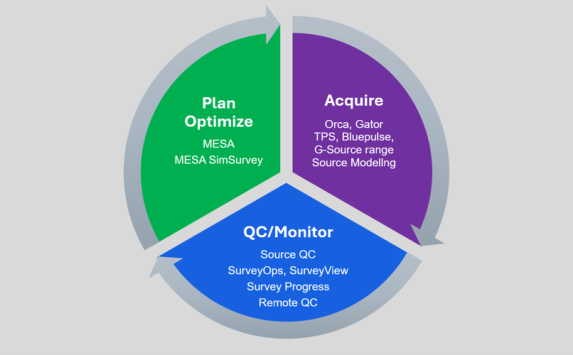
Sercel software as the key component in integration and communication
Once offshore, the relationship between source technology and acquisition software becomes very important.
Sercel’s Orca and Gator command and control systems have evolved to support sophisticated shooting strategies including simultaneous shooting, offset array shooting, apparition, per-array dithers, hybrid shooting, dispersed source array (DSA) and UHR shooting. Hybrid shooting is particularly interesting as it allows different sources to fire at different rates, so a conventional source and TPS can be incorporated into the same firing sequence.
Orca and Gator navigation systems continue to be the industry standard and play a central role in the integration of hardware and across functions to provide automated source QC, including remote QC. Sercel also offers automated QC for the seismic data itself, delivering a fully integrated QA/QC package.
Get more from low frequencies
Low-frequency performance remains a major focus of source development.
A reliable low-frequency signal helps build better earth models, improves imaging under salt and basalt, mitigates cycle skipping in full waveform inversion (FWI), reduces FWI turnaround time, improves resolution thanks to reduced sidelobes and reduces dependency on well logs to provide the low-frequency content for reservoir characterization. This can provide useful subsurface information early in the project.
TPS was developed to provide the strong low-frequency broadband signal needed for advanced FWI without compromising the high frequencies required for detailed seismic imaging. It has now acquired more than six million shots, with a reported productivity of 98%. TPS also has less technical down time and a wider weather window than any other seismic source.
Data presented at IMAGE 2026 showed a signal-to-noise crossover of approximately 0.9 Hz for TPS, versus 1.2 Hz for other LF sources and 1.6 Hz for the conventional airgun configuration included in the comparison.
We must remember that broadband acquisition is not simply about going lower. The objective is to deliver the bandwidth needed for the imaging challenge, and the TPS solution produces excellent results across all frequencies.
Match the source to the job
TPS can operate at different volumes, with testing ranging from 600 cui to 28,000 cui. Smaller volumes require less air per shot and refill faster, allowing shorter inline shot intervals.
This creates opportunities to combine smaller sources on a dense shot pattern with a larger TPS on a sparser pattern. Rather than expecting one source to do everything, the source strategy can be designed around the survey requirements. In addition, having an operating pressure at 1000 psi give us flexibility to efficiently increase the shot carpet when compared to other sources on the market.

Consider environmental performance from the start
Source modeling, technology selection and survey planning can help address environmental considerations while still meeting geophysical and operational objectives.
The Sercel source portfolio provides different options for different requirements. Bluepulse, for example, uses bandwidth-controlled G-Source II technology for deepwater surveys in environmentally sensitive areas, while TPS combines low-frequency broadband performance with a reduced environmental footprint. TPS was also validated by NOAA Fisheries and BOEM as having the lowest environmental footprint among available ULF sources.
Connect planning with performance
Optimization does not stop when acquisition begins.
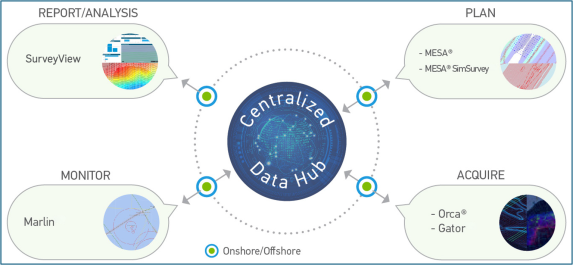
While Orca and Gator deliver production statistics and source attributes, Sercel’s SurveyView provides a platform for sharing and visualizing information. Dashboards give project teams access to real-time data and key performance indicators throughout the survey.
This creates a feedback loop between what was planned, what is happening offshore and how the source is performing for all project stakeholders, offshore and onshore.
Look beyond the source
Source volume, pressure, frequency content and output remain fundamental to marine seismic acquisition. But they no longer tell the whole story.
The real opportunity lies in connecting survey design and simulation, source modeling, technology, acquisition software, monitoring and field expertise.
The objective is straightforward: better seismic data, more efficient and safer acquisition, informed decision-making and lower environmental impact, while keeping a close eye on survey economics.
That is what we mean by going Beyond the Source.

Meet your Offshore Exploration Expectations with Sercel
Learn more about our solutions for your next offshore energy exploration project.